Gold Mining & Gold Discoveries
Topic guide · Updated October 2026
Every gram of gold in a coin, a ring or a smartphone began its journey in the Earth's crust. Finding it and getting it out has shaped the history of entire countries — from the gold rushes of California, Australia, South Africa and the Klondike to the vast modern mines of today. This guide explains how gold is found and mined and brings together all our articles on mining and discoveries.
How gold deposits form
Gold is rare: on average, the Earth's crust contains only a few grams of gold per thousand tonnes of rock. Mineable deposits form when natural processes concentrate it. Hot fluids circulating deep underground — often linked to volcanic activity — dissolve gold and deposit it in quartz veins and other rocks. These are called lode or hard-rock deposits.
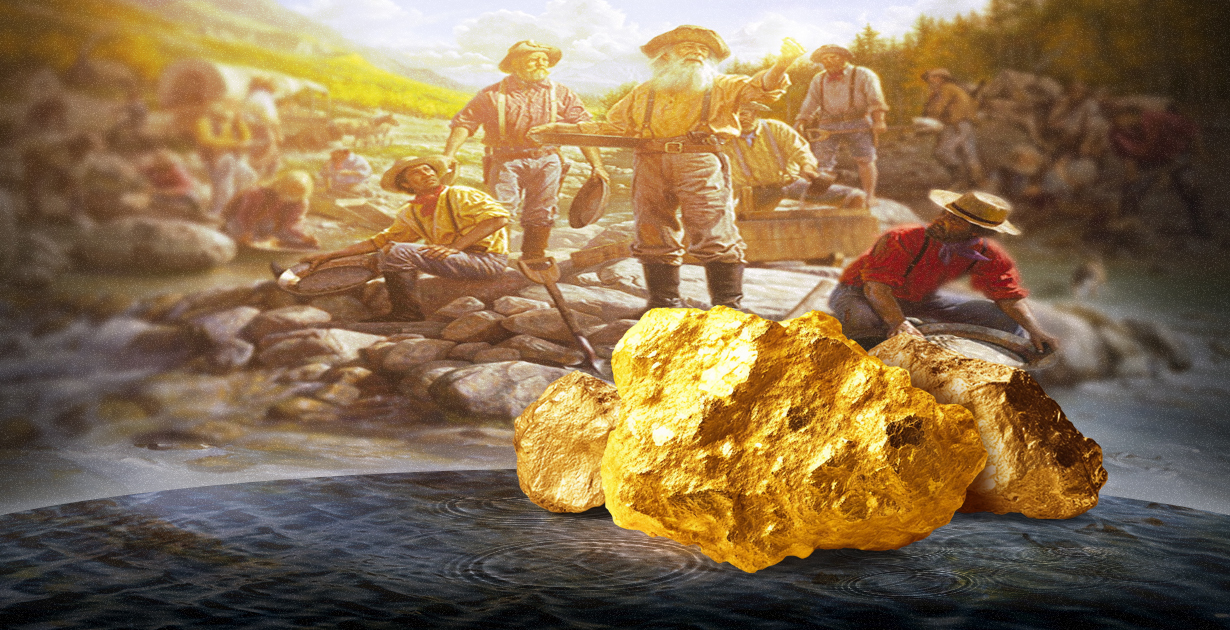
When gold-bearing rock erodes, rivers carry the heavy gold particles downstream, where they collect in gravel and sand. These alluvial or placer deposits are where most historic gold rushes began, because gold could be recovered with simple tools such as pans and sluices.
The great gold rushes
- California (1848): gold found at Sutter's Mill on the American River started one of the largest migrations in American history.
- Australia (1851): discoveries in New South Wales and Victoria transformed the colonies and made Melbourne one of the richest cities in the world.
- South Africa (1886): the Witwatersrand discovery led to the founding of Johannesburg; the region has produced more gold than any other in history.
- Klondike (1896): a find on Bonanza Creek in Canada's Yukon sent tens of thousands of prospectors north.
Legendary nuggets
Nuggets are natural lumps of gold. Very large ones are extremely rare. The "Welcome Stranger", found in Victoria, Australia, in 1869, yielded more than 70 kg of gold and is still regarded as the largest alluvial gold nugget ever found. The "Hand of Faith", found with a metal detector in Victoria in 1980, is one of the largest nuggets still in existence.
How modern mining works
Modern gold mining is a long and expensive process. Exploration can take years, and only a tiny share of prospects become mines. Large deposits are worked in open pits or deep underground — some South African mines reach depths of nearly 4 kilometres. The ore is crushed, and gold is recovered by processes such as gravity separation, flotation and leaching, then refined into bars. From discovery to first production can take 10 to 20 years, and a mine may operate for decades.
Responsible mining
Mining brings jobs and investment, but it also affects land, water and communities. Responsible producers follow environmental and social standards, while illegal mining — for example in parts of the Amazon — is linked to deforestation and mercury pollution. Recycling also plays a growing role: a significant share of the gold supply each year comes from recycled jewellery and electronics.
Amateur prospecting
Gold panning and metal detecting remain popular hobbies in many countries. Before searching, always check local rules — many areas are private claims or protected land, and permits are often required.
Frequently asked questions
Where was the largest gold nugget found?
The "Welcome Stranger", found near Moliagul in Victoria, Australia, in 1869, yielded more than 70 kg of gold and is regarded as the largest alluvial gold nugget ever found.
Which region has produced the most gold in history?
South Africa's Witwatersrand basin, discovered in 1886, has produced more gold than any other region in the world.
How long does it take to open a gold mine?
From discovery to first production it often takes 10 to 20 years, because of exploration, feasibility studies, permits and construction.
Can I still find gold in rivers?
Yes, small flakes can still be found in many gold-bearing rivers, but large finds are rare. Always check local rules and permits before panning or detecting.
Recommended reading
- The Most Famous Rivers with Gold Deposits
- 5 legendary gold nuggets of the 19th century
- Gold rush in California: what you might not know about it?
- How long does a gold mine last?
- “Hand of Faith”: how an Australian found a unique gold nugget
- A new Gold Rush on California’s horizon
- Mining gold from water: fiction or reality?
- Nugget from the “Golden Triangle”
All articles on this topic (21)
- 5 legendary gold nuggets of the 19th century
- Taupo: gold in the heart of a volcano
- The Most Famous Rivers with Gold Deposits
- Nugget from the “Golden Triangle”
- What’s hidden behind the doors of the most secure depository in the United States?
- “Hand of Faith”: how an Australian found a unique gold nugget
- Gold rush in California: what you might not know about it?
- A new Gold Rush on California’s horizon
- How long does a gold mine last?
- Unusual hobby: gold panning championships
- Mining gold from water: fiction or reality?
- Volcanic gold
- Gold Rush: South Africa
- Gold Rush: Canada
- Gold Rush: Brazil and the USA
- Gold mining in Peru: a story through a series of photos
- The "odd" gold mineral — Calaverite
- Discovery: Gold nuggets worth millions of dollars
- California Shines Bright: Gold Rush After Floods
- How to benefit from the gold price drop? - Brent Cook, the mining expert
- Gold nuggets enter the market through the front door!