The Golden Knife: the Power Symbol of a Bygone Age
Average reading time — 4 minutes
For most of history a knife was an everyday tool. A knife with a golden hilt or a golden blade was something else entirely: a sign that its owner stood above ordinary people. Kings, pharaohs and sultans wore ceremonial daggers not to fight but to show their rank, their wealth and their connection to the gods. Here are some of the most famous golden knives in history and the stories they tell.
The two daggers of Tutankhamun
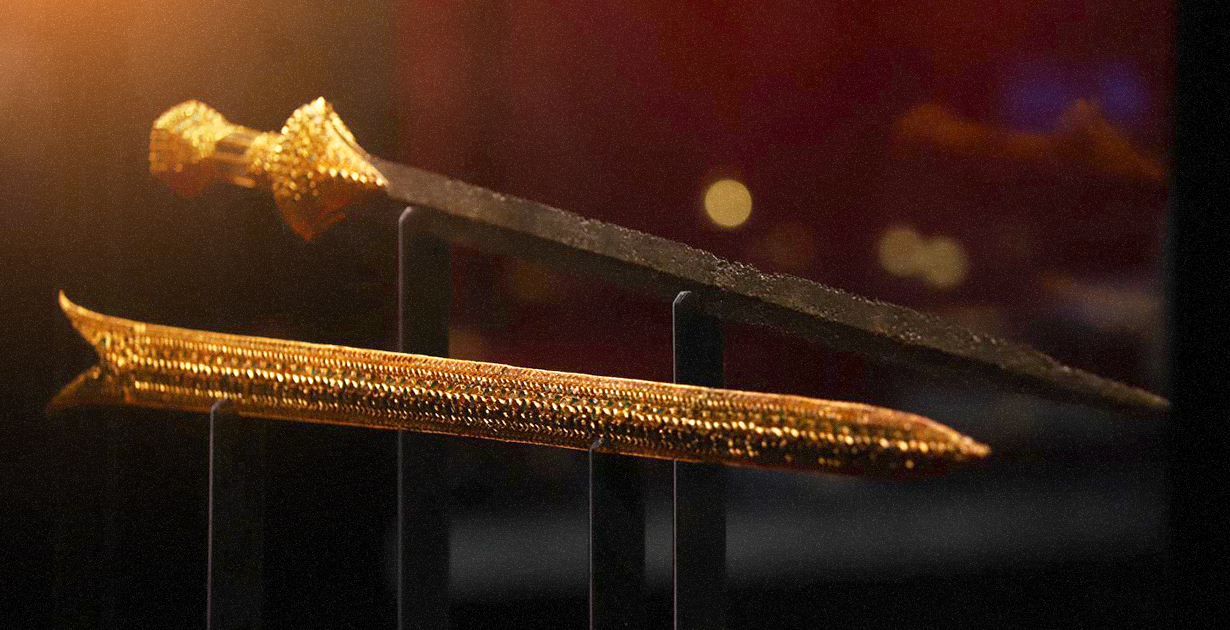
When Howard Carter examined the mummy of Tutankhamun in 1925, he found two daggers hidden in the linen wrappings. The first has a blade of gold and a gold sheath decorated with hunting scenes of animals. The second is even more remarkable: its handle is made of gold decorated with granulation and inlays, but its blade is made of iron that has stayed bright and almost free of rust for more than 3,300 years.
In the Bronze Age, iron was rarer and more precious than gold. In 2016 a team of Italian and Egyptian researchers analysed the blade with X-ray fluorescence and found a high nickel content and traces of cobalt — the chemical signature of iron from a meteorite. The king was literally buried with a "blade from the sky". A later study in 2022 suggested that the dagger may have been made outside Egypt, which fits ancient diplomatic letters: King Tushratta of Mitanni wrote to Pharaoh Amenhotep III that he was sending, among other gifts, a dagger with an iron blade and a gold sheath.
Scythian gold: the warrior's status
The nomadic Scythians, who lived on the steppes north of the Black Sea, were famous goldsmiths. Their short swords, known as akinakes, were often placed in burial mounds with scabbards covered in gold sheet and decorated with animals — deer, panthers, griffins. Several such gold scabbards from royal kurgans of the 7th–4th centuries BC are now among the treasures of the State Hermitage Museum. For a Scythian leader, a gold-mounted sword was a badge of command that he took with him into the afterlife.
The Topkapi Dagger: emeralds and gold
One of the most famous ceremonial daggers in the world is kept in the Topkapı Palace Museum in Istanbul. It was made in 1747 on the orders of the Ottoman sultan Mahmud I as a diplomatic gift for Nader Shah of Persia. The gold hilt is set with three large emeralds, and the top of the handle hides a small watch beneath a fourth emerald lid. Before the embassy carrying the gift reached Persia, Nader Shah was assassinated, and the dagger returned to Istanbul. In 1964 it became world-famous as the target of the jewel heist in the film "Topkapi".
Why gold?
There are practical reasons why gold was chosen for the most prestigious knives:
- gold does not rust or tarnish, so a gold hilt or sheath keeps its shine for centuries;
- it is soft and easy to work, which allowed goldsmiths to create fine granulation, filigree and inlays;
- it was rare and controlled by rulers, so only the elite could afford it.
Because gold is too soft to hold a sharp edge, most "golden" knives combine a working blade of bronze, iron or steel with a gold handle and scabbard. Tutankhamun's gold-bladed dagger was a ritual object rather than a weapon.
A symbol that outlived its age
Today ceremonial daggers are no longer signs of royal power, but they remain among the most valued items in museums and auctions. They show how, across very different civilisations, people chose the same metal — gold — to express authority, prestige and permanence.
Read also the article:
Topic guide: Gold in History & Ancient Treasures
A gold torc of the Bronze Age — the first of its kind in Essex
A symbol of Venetian authorities
Golden cup from the Bronze Age