The Secret of the Golden Spur's Order
- Original name: Order of the Golden Militia
- Awarded by: the Pope
- Special inscriptions: the date MDCCCCV (in Roman numerals) and "Pius X Restituit"
- Value: priceless
A disputed origin
Some historians believe the Order of the Golden Spur dates back to the time of the Roman emperor Constantine the Great. Others credit Charles I of Anjou, brother of King Louis IX of France, with the idea of honouring nobles for their loyalty. These early stories are legendary, and most researchers link the formal papal order to the 16th century, when Pope Pius IV regulated it.

Today the order is considered one of the highest papal honours.
What the insignia looks like
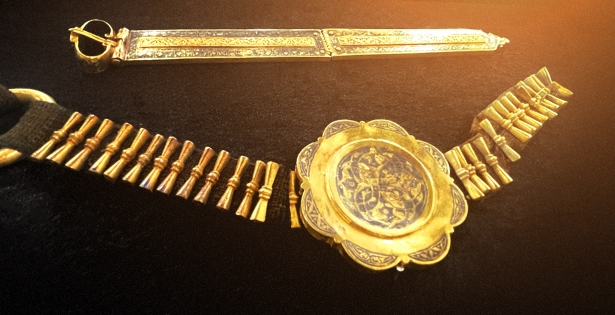
At first the papal award was a cross covered with white enamel, worn on a chain. Later its appearance changed: craftsmen made a Maltese cross with a central medallion bearing the image of Saint Sylvester, with a golden spur hanging between the lower arms. In 1905 Pope Pius X reformed the order. Since then it has been a Maltese cross with a medallion showing a monogram with the letter M and a crown, with an elegant golden spur between the arms.

Knights of the Golden Spur
It is impossible to put a price on the order. It was awarded only in exceptional cases, which makes the papal honour priceless. Early recipients included musicians, painters and scholars: the Florentine sculptor Baccio Bandinelli, the painter and architect Giorgio Vasari, the Venetian master Titian and the young Wolfgang Amadeus Mozart, who received it in 1770 at the age of 14.
Popes also gave the honour to statesmen, including King Paul of Greece and Konrad Adenauer, the first chancellor of the Federal Republic of Germany.
Since the 20th century the order has been reserved for Christian heads of state, and in recent decades it has very rarely been awarded, which makes it one of the rarest honours in Europe.
Gold as a symbol of merit
In many cultures gold is associated with success and achievement. For centuries it has been used to make jewelry, the most valuable awards and many symbols of power. Gold objects keep their shape and shine for centuries — an important quality for decorations that are meant to preserve the memory of their holders' merits.
Read also the article:
The golden bulla: history, culture, medieval laws
Topic guide: Gold in History & Ancient Treasures
Legend of El Dorado: gold of the South American Indians
Predictions of antiquity: a secret tool
The secret of the lady with gold rings